
Ninety vs MonsterOps: Which Business Operating System Wins in 2026?
Jeremy Chatelaine · Last updated
Compare Ninety and MonsterOps on features, usability, pricing, and fit so you pick the right operating system for 2026.
Summarize with ChatGPTSummary
Ninety is a mature, enterprise-friendly platform for teams that want strict EOS® structure and a longer market track record. MonsterOps is the stronger fit for most small and mid-sized operators that want a faster and simpler interface, broader framework flexibility, and real AI integration for a fraction of the price.
Introduction
Whether you run your business on EOS®, Scaling Up, or even plain OKRs, you already know that having multiple tools scattered everywhere makes it difficult to take full advantage of the visibility and accountability those frameworks offer.
Both MonsterOps and Ninety solve this by giving you one place for your rocks, your KPIs, your issues, and your meetings. So what's the difference?
At their core, they have very different views on what makes a good business operating system software, and that has very real consequences for the business you are running.
Pick the wrong one and you may be stuck with a yearly contract you regret, poor adoption, slow innovation, a bad rollout that never gets past the leadership team, or a bill that grows out of control.
This guide helps you understand the differences that matter and the drawbacks of each solution, so you can make a better-informed decision.
Quick Overview
Ninety has been around since 2017. It is one of the best-known names among EOS® practitioners, with more than 40,000 companies on the platform. That history means a deep feature set, a large user base, and a lot of coaches who already know it.
MonsterOps launched in 2025 with a different starting point. Modern and faster interface. Framework-agnostic for maximum flexibility. AI support built deep into the product instead of bolted on. And flat pricing to benefit your whole company, not just the leadership team.
Ninety optimized for EOS® correctness over its years in market. MonsterOps optimized for accountability, visibility and maximum adoption at every level.
This article is about figuring out which one is right for you.
Where Ninety Wins
Let's be fair. Ninety is a strong product, and there are real reasons companies pick it.
Enterprise features. Ninety is built for larger organizations. If you have hundreds of employees, multiple departments, and a real need for granular permissions and administrative control, Ninety has had years to build that out.
Strict framework adherence. If your team wants EOS® exactly by the book, Ninety enforces that structure tightly. Every component maps to the methodology. They managed to build strong relationships with many EOS® implementers over the years. If you hired an EOS® implementer, chances are they know the software already.
A large, established ecosystem. With years of experience and tens of thousands of companies on the platform, Ninety has the kind of community, documentation, and partner network that only time creates. If you want the safe, well-worn path, that counts for something.
If you are a large enterprise with complex governance needs and a hard requirement for by-the-book EOS®, Ninety deserves a serious look.
Where Ninety Falls Short
These are things that are often too easily overlooked, but may end up being problematic with time.
Innovation and modern engineering. With so many years of operation and quasi-monopoly, it's easy to become complacent. Lack of competition made them slow to innovate and adapt to new needs on the market. They only started adding an API this year on the highest price tier, and it still doesn't allow users to read their own scorecard values. If you want to modernise your operation to integrate Ninety with the rest of your stack, you will feel the pain.
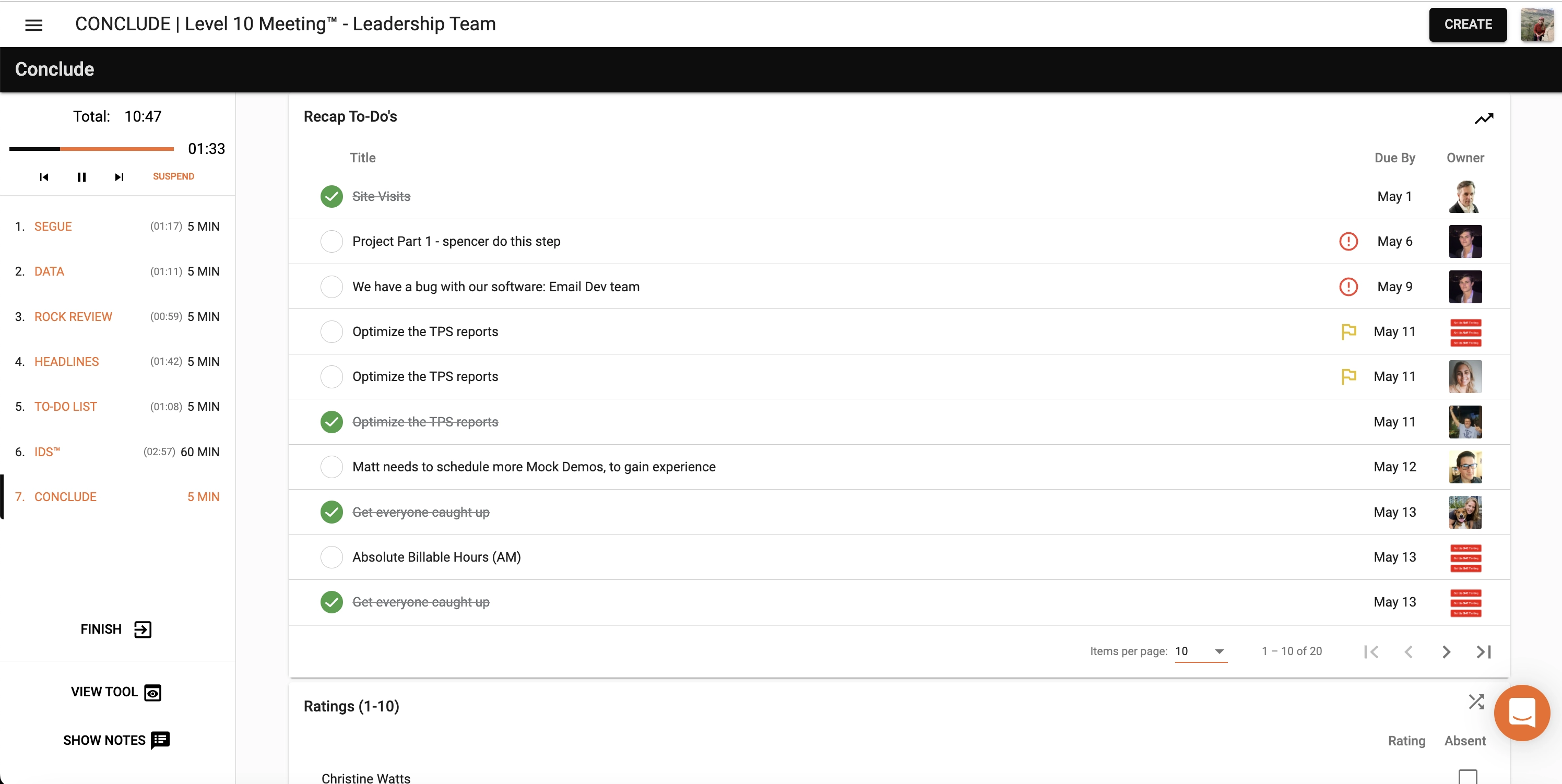
User experience. This is a very common complaint. Teams find the interface heavy and clunky. It can feel slow to operate when you are trying to run a fast meeting and create to-dos on the fly. In a tool you touch every week, friction adds up quickly. Digital natives will drag their feet when required to use it. It's probably why they aren't boasting about adoption rates among users with their software.
Pricing that you will feel. Ninety charges per user. Essentials is $12 per user per month. Accelerate is $14. Thrive is $16. That looks reasonable at five seats. It looks very different at 50 or 80. Every hire raises the bill, and that creates a quiet incentive to limit who gets a login. Unless you want to play the game of managing licenses, you will pay extra, and you may wonder why you are paying so much for a tool that just centralise your data at some point. We will come back to why that is a problem.
Where MonsterOps Wins
MonsterOps was built to maximise adoption for your whole company.
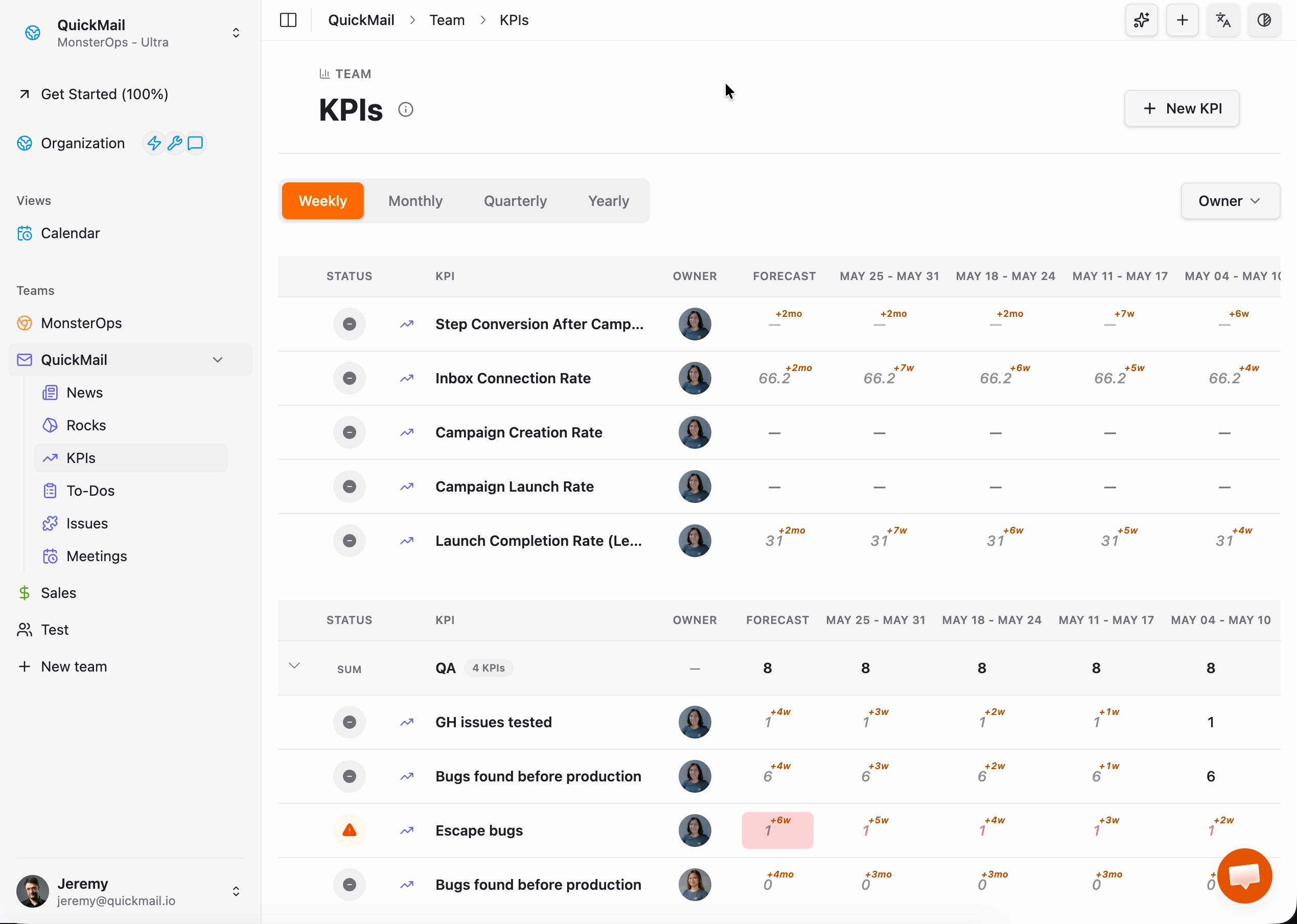
A simple interface built for maximum adoption. MonsterOps is built to minimize the need for training through simplicity and good design. Operators won't have to fight the tool. Digital natives will love the interface and how responsive the application is, while non-technical users will love how simple and easy it is to change things around.

Samuel T.
"I actually tried Ninety first but prefer the simplicity of MonsterOps."
Framework flexibility. MonsterOps is framework-agnostic. We have users who run EOS®, Scaling Up, OKRs, 4DX, a blend of them, or their own business operating system. MonsterOps is not affiliated with any framework, but is flexible enough to let you run your company the way you want. You can easily pick and choose what works for you.

David
“MonsterOps has been great for our team to power our EOS operations. It's simple and clear for everyone on our team to learn and implement into their workflow without feeling like they need to learn an entirely new system.”
Future-proof. Automate your metrics through the powerful API. Use native integrations or rely on AI agents to make your work easier and provide real-time visibility into your company. You spend less time copying figures between tools and more time acting on them.
Native AI. MonsterOps AI is not a simple chatbot add-on. It gives you concrete insights on your data and coaches you and your team on best practices. Receive the relevant support you need in seconds.
A steal. MonsterOps is not priced per-seat. It's one paid plan with everything in it. Free for teams of up to 10 people, or $99 per month, billed annually, with unlimited users, API, and MonsterAI. The pricing is not just cheaper. It changes the decision you make about who gets access. No need to manage licenses and forecast usage based on hiring projections or have another yearly discussion with the CFO on the value of using a business operating system software.
Where MonsterOps Falls Short
MonsterOps is not for everyone. It has some aspects that can make it impractical for some companies.
Newer to market. MonsterOps launched in 2025. Ninety has years of head start, is well established and slow to change. If a long commercial track record is a hard requirement for you, that is a real point in Ninety's favor.
Simpler permissions. MonsterOps provides a complete audit log but has simple permissions and assumes a high-trust environment. If you are a very large or highly regulated enterprise that needs deeply granular access models with dozens of custom roles, MonsterOps may be simpler than you need.
Focused scope. MonsterOps runs your operating system (KPIs, Meetings, Issues, Rocks...). It is not trying to be your HR platform, your CRM or your full enterprise project management suite. If you want one tool to do everything from strategy through daily operations, MonsterOps is not it. We do one job and we do it well.
No blind obedience. This one may sound odd, but it's a very important point. If you are looking for a certified operating system, MonsterOps is not it. It is framework-agnostic and therefore can move fast, propose the best tools independently of the framework used and isn't arbitrarily slowed by licensor approval processes.
Feature by feature
If you are interested in how the two stack up on the things you will actually use every week, here are a few points to check.
Rocks and quarterly goals. Both tools handle quarterly goals (Rocks) well. Ninety maps rocks tightly to the EOS® model and provides on track/off track/canceled or completed as statuses. MonsterOps gives you the same quarterly goal structure but lets you frame it your way with objectives. This allows you to easily implement cascading goals or simply see what rock contributes to the overall objectives of the company. It also adds additional statuses like backlog (idea of a future rock), planned (rock well defined with milestones but not for this quarter) or at-risk (when a rock is on track but may become off track if something is not addressed on time; e.g. something that needs to be done in another department, or regulation).
Scorecard/KPIs: Both give you a weekly scorecard (called KPIs in MonsterOps) with measurables and owners. The difference shows up in upkeep. MonsterOps allows you to keep numbers current through integrations and AI agents. Ninety gives you scorecards that look like a spreadsheet. MonsterOps quickly and visually surfaces KPIs that need discussing.
Issues. Both maintain an issues list for the things that need solving. The mechanics are similar: capture, prioritize, discuss, resolve. MonsterOps allows more flexibility in allowing to easily convert issues into to-dos and vice versa.
To-dos. Both track action items out of meetings. MonsterOps notifications include overdue visibility for your direct reports so managers see what is slipping without chasing it down. More accountability, fewer dropped balls.
Meetings. Both run a structured weekly meeting in the Level 10 style. This is the heartbeat of any operating system. Ninety's meeting flow is thorough and by the book. MonsterOps allows a lot more flexibility in how to run your meeting and focuses on efficient meetings. It incorporates a randomized icebreaker (no awkward wait for who should go first) and hidden rock status to re-commit every week to a status.
AI, the future. This is a clear gap. Although Ninety has added AI features at its top Thrive tier, including a rock companion and meeting prep in beta. It's really more a gimmick than a true innovation. MonsterOps native AI has AI included in any subscription and allows you to query all your data at any time (including in the middle of a meeting) and include coaching capabilities. One treats AI as additional revenue add-on. The other treats it as the future of business operating systems and wants everyone to benefit from it.
Integrations and API. MonsterOps offers a powerful API to do anything. Automate your data to keep it current with less manual effort. Ninety took months to release its API, and it still can't read your own scorecard values or access the whole team's to-dos. Just imagine how fast it will release your request for improvement. If connecting your operating system to the rest of your stack matters, this is worth testing in a trial before you commit.
Audit trail. MonsterOps keeps a full audit trail (with possibility to revert any action) so you can see who changed what and when. On top of that, the AI can surface insights from that history, making it perfect to ask about team member performances. It is the kind of visibility that makes accountability real instead of theoretical.
Onboarding and training. Ninety's bloat means a steeper learning curve, which is part of why an ecosystem of coaches exists around it and they have to double down on human support. MonsterOps is built so you do not need training to use it. You sign up and you run your first meeting in under 3 minutes and have access to scary good AI to support you in seconds. No excuse to get started. Radical simplicity is the whole point.
Permissions. Ninety is the clear winner here for complex or low-trust orgs that need more granular roles. MonsterOps keeps it simple and provides full auditing in case something is going wrong. Match this to your actual governance needs, not to a checklist of features you will never turn on.
The adoption problem
An operating system only works best if your company adopts it. Not just the leadership team. Everyone who owns a number, every team running a meeting, solving their issues and executing their to-dos.
Per-seat pricing creates a misalignment. When every login costs money, someone has to decide who is worth a seat. And $14 to $16 per employee adds up quickly. Do you put your half-time contractors on it? Do you use it with the agencies you contract? If you need to have a discussion with the CFO every time you need to provision new licenses, that's a pain. It's obvious that the answer to more predictability is to over subscribe the number of licenses. This can be painful with yearly billing. That's adding friction, not facilitating the adoption.
Flat pricing removes the question entirely. When adding a user costs nothing, you add everyone without question. The frontline lead owns their own metric. The manager updates their own rocks. Accountability lives where the work happens, not two layers up.
This is why we built MonsterOps that way. The flat price is the only logical way to promote adoption. We think whole-company adoption will lead to greater benefit for our users and so we priced the product accordingly.
Who Should Choose What
Choose MonsterOps if:
- You are a small or mid-sized business that values execution speed.
- You don't want to be pigeonholed into one framework or only want to adopt parts of it.
- You want every person in the company on the system, not just leadership without having to play with licenses.
- You want a native AI system working for you instead of AI as an afterthought.

Braden
“We’ve been using EOS in our business for a number of years but had struggled to find a reliable, cost effective, and user friendly EOS implementation tool online. I stumbled across MonsterOps and couldn’t be happier that I did! Its functionality is equal or better than some of the other software we’ve used but at a fraction of the cost.”
Choose Ninety if:
- You are a large enterprise with complex permission and governance needs.
- You need strict EOS® conformity enforced by the software with no deviations.
- You want recognized brands and the largest coach ecosystem.
- Per-seat costs at scale are not a concern for your budget.
Verdict
For most teams running EOS®, Scaling Up, Pinnacle, or OKRs, they may find MonsterOps to be a more practical, future-proof, and cost-effective option.
An agent-ready MCP Server, a comprehensive API, AI-native support, and unlimited seats after your first 10 users make growth planning easy. You never have to ask whether one more person is worth a license or wonder when Ninety will wake up and build the future.
Ninety remains a strong choice for large enterprises with complex requirements and a hard need for by-the-book EOS®. If that is you, trial it. But for the small and mid-sized operator who wants speed, flexibility, access to modern technology and a system the whole company actually uses and loves, MonsterOps is built to give you just that.
In the end, the best way to decide is to run both for a week. Put your real metrics in each. Run a real meeting in each. And see which one your team actually wants to open on Monday morning.
Cost calculator: MonsterOps vs Ninety plans
Here is what the per-seat model costs as you grow, across Ninety Essentials, Accelerate, and Thrive. MonsterOps stays flat at $129/mo (or $99/mo when billed annually), no matter how many people you add.
MonsterOps
$129/mo
$129/mo month-to-month with unlimited users.Ninety Essentials
$300/mo
$12 x 25 users.Ninety Accelerate
$350/mo
$14 x 25 users.Ninety Thrive
$400/mo
$16 x 25 users.Migrating from Ninety
Made the wrong decision? It happens. Switching tools sounds painful. These days, it is not with AI. All operating systems use structured data: rocks, measurables, issues, to-dos, meeting history. That structure carries over cleanly.
MonsterOps includes concierge migration from Ninety. We move everything for you without any additional cost so your team does not start from a blank screen. You keep your history. You keep your cadence. The Monday meeting still happens, it just happens in a better tool.
The easiest way is to migrate at a quarter boundary. Finish your current quarter in Ninety, close out the rocks, then start the new quarter fresh in MonsterOps. You lose nothing and your team gets a clean line between the old system and the new one.
If you are worried about the leadership team relearning a tool, know that MonsterOps is built with simplicity in mind, so learning it takes just one meeting. And if you are lost, the AI is here to guide and coach you every step of the way at your pace.
Try MonsterOps for free
Free for teams of up to 10 people, then $129/mo with unlimited seats and easy migration from Ninety.